Why AI projects fail – and why the model is rarely the problem
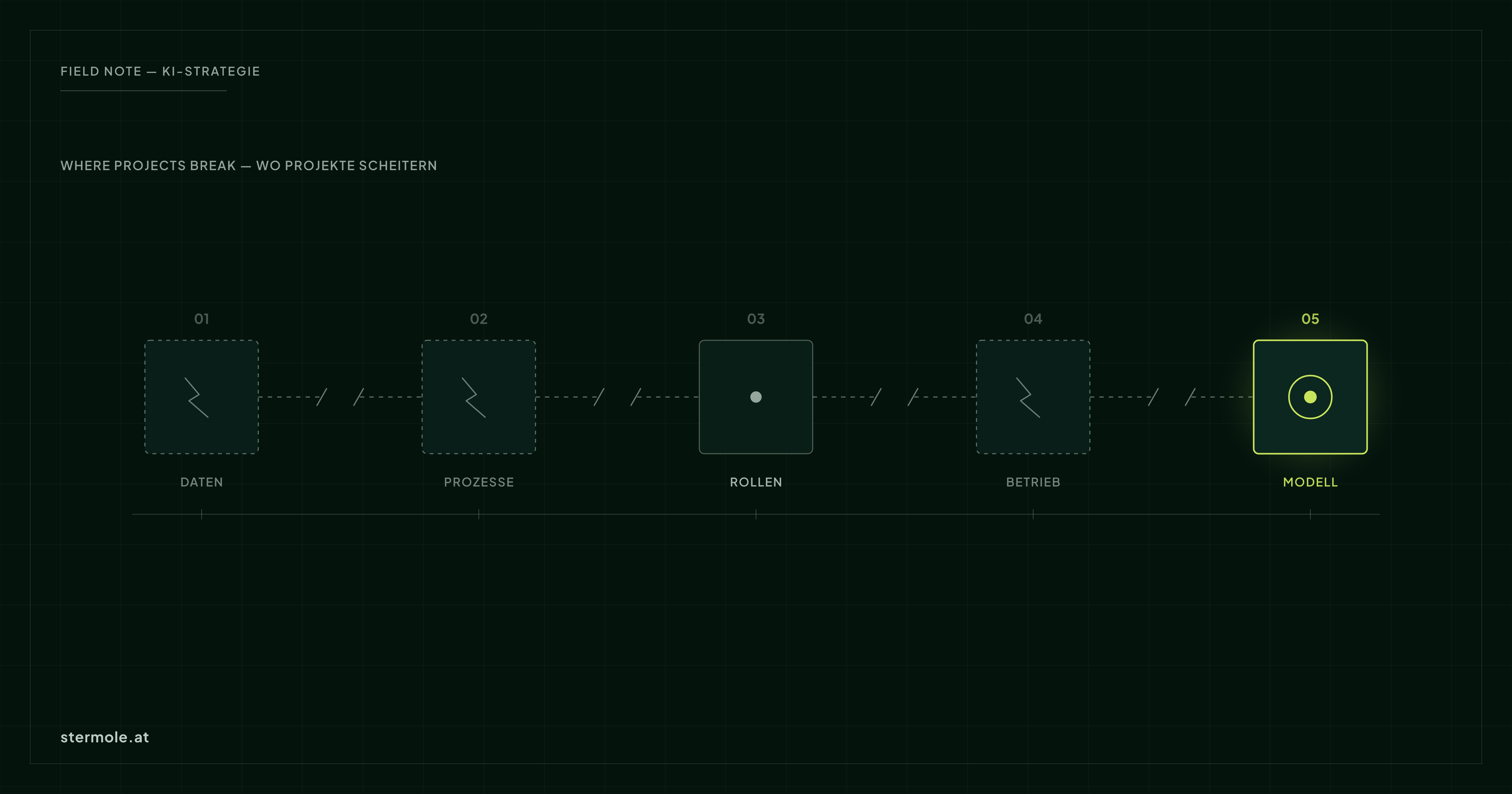
When an AI initiative stalls, the first reaction is often: "We need a better model." That is understandable because the LLM is the most visible component. In practice, the bottleneck is frequently elsewhere – data, process, integration, evaluation, ownership or operations.
A capable model cannot compensate for a weak system architecture.
The first question should therefore not be "Which model?" but: Which task needs to work more reliably – and how will we know that it does?
The short answer: why AI projects fail
Eight causes appear repeatedly:
- no clear business case,
- unsuitable or inaccessible data,
- no measurable quality criteria,
- unclear ownership,
- integration considered only after the PoC,
- security, privacy and permissions addressed too late,
- no operating model,
- weak adoption in the real workflow.
The model can be technically excellent while the project still fails to produce dependable value.
1. The business case remains abstract
"We want to use AI" is not a use case.
A useful use case states:
- who performs the task today,
- what concrete problem occurs,
- which information is needed,
- what outcome is expected,
- which errors are tolerable,
- and how an improved state can be observed.
"An internal knowledge chatbot" is broad. "Service staff can find the current technical policy for product group X, with a citation, in under two minutes" is much easier to design and test.
The more concrete the task, the easier it is to align data, architecture and evaluation.
2. The data does not match expectations
AI initiatives often fail not because there is too little data, but because the real data landscape is different from the slide deck.
Typical issues:
- multiple versions of the same information,
- outdated documents,
- missing critical knowledge,
- historically grown permissions,
- PDFs that parse badly,
- important systems that are difficult to integrate,
- unclear business ownership.
A RAG system can only retrieve what exists in a usable form.
If several systems need to be connected, Connect RAG data sources explains synchronization, ACLs, metadata and deletion handling before the first embedding is generated.
3. Nobody defines what "good enough" means
A good demo is not a quality criterion.
If a team asks ten questions and eight answers "look fine", that does not establish production readiness.
A pilot should define in advance:
- representative test questions,
- expected sources or results,
- critical failure classes,
- acceptable answer boundaries,
- latency requirements,
- clear stop/go criteria.
For RAG, retrieval quality, groundedness and citation accuracy matter. For agents, tool calls, approvals and side effects matter too.
Without explicit criteria, every change becomes a subjective debate.
4. Ownership falls between business and IT
Who owns answer quality? Who decides which sources are valid? Who may change a prompt, model or retrieval rule? Who responds to an incident?
AI systems blur responsibilities across business teams, IT, security, privacy and vendors.
Before go-live, the system needs at least a business owner and a technical owner. Critical workflows also need approval and escalation paths.
5. Integration comes too late
Many PoCs live in a separate chat window. That is convenient for a demo but often not where users actually work.
Production value appears when AI fits the real process:
- existing application,
- DMS,
- CRM,
- ERP,
- service desk,
- email or document workflow,
- internal platform.
That introduces questions the PoC may not have answered: identity, permissions, write-back, error handling, citations, auditability and ownership.
The integration boundary should therefore be considered during the pilot, not after it.
6. Security, privacy and permissions are postponed
A system that works with test data proves little about real operations.
Once real company data is involved, teams need to understand:
- which data is processed,
- who may access it,
- which systems or providers are involved,
- where data is stored or transferred,
- what logs are generated,
- how tenant or department boundaries are enforced.
For RAG, permission-aware retrieval is particularly important: AI must not become an alternative path around existing access controls.
A sovereign or local architecture can increase control but is not automatically GDPR-compliant. See Sovereign AI for companies for the technical operating-model view. This does not constitute legal advice.
7. Operations are invented after the pilot
A PoC can survive manual imports and one developer. Production needs more.
At minimum, clarify:
- monitoring,
- failure analysis,
- data and index freshness,
- model and prompt changes,
- regression tests,
- cost,
- latency,
- backup and recovery,
- security updates,
- incident ownership.
With fast-changing models and source data, "tested once" is not a durable quality guarantee.
8. The solution does not fit everyday work
Technical quality alone does not create adoption.
A system can produce good answers and still be ignored if:
- users must leave their workflow,
- answers cannot be verified,
- the interaction is slower than the existing path,
- users do not know when to trust the result,
- AI adds work instead of removing it.
That is why task success is more important than an isolated model metric. The question is whether the real task is completed better.
Architecture before tool choice
The question "Which tool?" almost always comes too early.
A better sequence is:
- Define the business task
- Clarify real data and permissions
- Create test cases and quality criteria
- Define target architecture and integration boundaries
- Build a small pilot
- Evaluate it against real cases
- Scale only after the evidence is clear
This keeps models, vector databases and frameworks replaceable components rather than premature architecture constraints.
Pilot vs production readiness
A pilot answers:
Can we implement a real value case with reasonable effort?
For a concrete framework covering scope, data, test cases, metrics and go/no-go, see Plan an AI pilot: from use case to a defensible go/no-go.
Production readiness answers:
Can we operate this system responsibly with real users, data, permissions and failure modes?
Good-looking demo answers are not enough.
A practical readiness review may cover:
| Area | Guiding question |
|---|---|
| Business fit | Does the system solve the defined task? |
| Data | Are sources current, complete and controlled? |
| Retrieval | Is the right evidence found? |
| Quality | Are important failures reproducibly measurable? |
| Permissions | Does every user only see allowed content? |
| Integration | Does the real end-to-end workflow work? |
| Security | Are relevant attack and misuse paths considered? |
| Operations | Are monitoring, ownership and regression tests in place? |
| Cost/latency | Is the system viable under realistic load? |
A practical 30-minute project check
If an AI project is stuck, answer these questions without discussing vendors:
- Who is the concrete user?
- Which task should improve?
- Which five real examples represent that task?
- Which sources are needed?
- Which failures would be business-critical?
- Who may see which data?
- Where must AI integrate into the existing process?
- Who owns quality and operations?
- What decides go vs no-go?
- Which assumption currently has the weakest evidence?
If several answers are missing, a model change is probably not the first lever.
What I would inspect first in a stalled AI project
I would not rebuild the system immediately. First separate the failure class:
- Target architecture unclear? Start with AI architecture consulting.
- Data sources and integration are the problem? Use RAG implementation & AI integration.
- A PoC exists but quality and go-live confidence are unclear? Use AI Production Readiness.
- Data sovereignty or hosting is the central constraint? See Sovereign AI.
Your PoC works in a demo, but nobody can reliably say whether it is production-ready?
→ Review the AI system before go-live
Technical guidance on privacy and compliance does not constitute legal advice.