What does private AI cost? Compare on-premise, EU cloud and SaaS

Private AI is not automatically cheaper than SaaS or a cloud API. A fair comparison adds implementation, infrastructure, model access, integration, ongoing work and exit. Every option must support the same workflow with sufficient quality, speed and control.
This guide provides a reproducible 12- and 36-month total cost of ownership calculation for an SME. Every euro amount is an explicitly chosen illustrative assumption, not a market price, supplier quote or measured project result. Replace these values with your quotes and pilot data.
As of 17 November 2026. Private AI vs public cloud covers the architecture decision behind the comparison. This article addresses its economics.
What are we comparing: SaaS, EU API, dedicated cloud and on-premise?
Private AI here means a deliberately controlled operating environment for a specific AI workflow. EU hosting initially describes a location; it alone says nothing about dedicated infrastructure or complete data paths.
| Option | What is purchased or operated? | What remains with the company? |
|---|---|---|
| SaaS | Finished assistance service with licences, features and usage limits | Adoption, data access, configuration, business review and permitted use |
| EU API with a custom application | Usage-based model access in a contractually verified EU region | Application, data integration, identity, evaluation and application operations |
| Dedicated EU cloud | Reserved model capacity with an agreed operating boundary | Application and runtime or operating tasks not covered by the provider |
| On-premise | Company-owned hardware and model runtime | Additionally, capacity, patches, recovery and hardware lifecycle |
SaaS and API are separate options. A SaaS subscription does not automatically include the API for custom automation. Conversely, an API-only application does not automatically require SaaS licences. Enterprise RAG: build vs buy helps distinguish purchased layers from those you own.
Check equivalent capability before calculating cost
The example covers one limited text-based assistance workflow for 25 active people: retrieving information from an approved text collection and drafting responses. People review the results. No autonomous ERP actions, OCR, speech processing or fine-tuning.
The numbers are comparable only if each option actually supports the required data access and workflow. If SaaS cannot meet the permissions or integration requirements, remove that column from the shortlist. A cheaper chat interface does not replace an integrated business application.
A real comparison needs these acceptance criteria:
- The same representative tasks, sources and business quality thresholds.
- The same access permissions and allowed data paths, including logs and external services.
- Agreed response time, peak usage and recovery objectives.
- A clear scope for support, updates and human rework.
The example assumes office hours, tolerable waiting times and no guaranteed high availability. A single on-premise system without redundancy is not comparable to a 24/7 service with contractual outage protection. The Enterprise AI Architecture Checklist examines these production requirements.
The transparent TCO model
TCO(n months) = implementation + hardware purchase
              + n × recurring monthly costs
              + additional costs during the period + exit reserve

Monthly costs = licences / inference + hosting / storage / backup
              + electricity + operational work + evaluation
              + integration maintenance + business rework
Internal work is valued at an assumed fully loaded hourly cost. It consumes economic resources even without a new invoice. A cash-flow plan must distinguish external payments from internal time.
Hardware is purchased once, without additional depreciation. This simplified budget model assumes constant prices and excludes financing, discounting, tax effects, inflation and residual value. Replacement during the horizon belongs in additional costs; none is assumed here. The full purchase is also included in the 12-month comparison: this deliberately penalises short usage periods and is not an accounting profit-and-loss view.
Assumptions: usage, tokens and staff time
| Input | Chosen assumption |
|---|---|
| Active users | 25 |
| Tasks per person per working day | 20 |
| Working days per month | 20 |
| Tasks per month | 25 × 20 × 20 = 10,000 |
| Input per model call | 6,000 tokens, including system prompt and source context |
| Output per model call | 1,000 tokens |
| Calls per task | Average 1.2, including retries |
| Billed API volume | 72 million input and 12 million output tokens per month |
| Hypothetical API tariff | EUR 2 / million input, EUR 6 / million output |
| Hypothetical SaaS licence | EUR 30 per person per month; sufficient allowance assumed |
| Fully loaded technical hourly cost | EUR 80 |
| Fully loaded business hourly cost | EUR 40 |
| Business rework | 10 hours per month in every option |
API inference therefore costs 72 × 2 + 12 × 6 = EUR 216 per month. No caching, batch or volume discounts are assumed. Hidden additional calls or other billable tokens must be added from real telemetry. Token counts can differ across models and tokenizers.
Separate input/output accounting corresponds, for example, to the billing dimensions in Scaleway's price list. The tariff values used here are not taken from that price list. SaaS allowances cannot simply be inferred from API tokens: the licence must cover the tested workflow and volume.
For on-premise, hypothetical average power consumption for the complete system is 0.25 kW: 0.25 × 720 hours × EUR 0.28/kWh = EUR 50.40 per month. This is neither measured consumption nor an Austrian electricity tariff. Add extra cooling if required.
Capture all initial and monthly costs
All amounts in euros excluding VAT. Provider services already included are not charged again as company work. The example assumes valid model and software licences without additional fees; check this assumption for the specific components selected.
| Initial cost item | SaaS | EU API | Dedicated EU cloud | On-premise |
|---|---|---|---|---|
| Architecture, data and access design | 3,000 | 3,000 | 3,000 | 3,000 |
| Configuration, integration and deployment | 2,000 | 8,000 | 10,000 | 10,000 |
| Test cases and initial acceptance | 2,000 | 2,000 | 2,000 | 2,000 |
| Adoption and training | 1,000 | 1,000 | 1,000 | 1,000 |
| Hardware purchase | 0 | 0 | 0 | 8,000 |
| Total initial cost | 8,000 | 14,000 | 16,000 | 24,000 |
Integration budgets are assumptions. The SaaS option configures an already supported connection; the other options require a custom application. Add actual work for additional connectors, data cleaning or security requirements.
| Monthly cost item | SaaS | EU API | Dedicated EU cloud | On-premise |
|---|---|---|---|---|
| Licences, API inference or reserved model capacity | 750 | 216 | 900 | 0 |
| Application hosting, storage, backup and infrastructure upkeep | 0 | 120 | 150 | 100 |
| Electricity, separate | 0 | 0 | 0 | 50.40 |
| Operations: monitoring, patches, restore tests; 4 / 6 / 10 / 14 hours × EUR 80 | 320 | 480 | 800 | 1,120 |
| Evaluation and model-change checks: 4 hours × EUR 80 | 320 | 320 | 320 | 320 |
| Integration maintenance: 2 hours × EUR 80 | 160 | 160 | 160 | 160 |
| Business review and rework: 10 hours × EUR 40 | 400 | 400 | 400 | 400 |
| Total monthly cost | 1,950 | 1,696 | 2,530 | 2,250.40 |
For on-premise, the EUR 100 item includes assumed external backup storage and infrastructure materials, not operational hours charged again. Cloud energy is included in the capacity/hosting assumption. OCR, embeddings, reranking, commercial licences and external fallbacks are not separately required in the example. If your workflow needs them, add explicit line items.
TCO comparison over 12 and 36 months
The exit reserve represents an assumed change at the end of each horizon. Without a change it remains a budget reserve. Actual export, rebuilding indexes, evaluation, parallel operation and decommissioning may cost more or less.
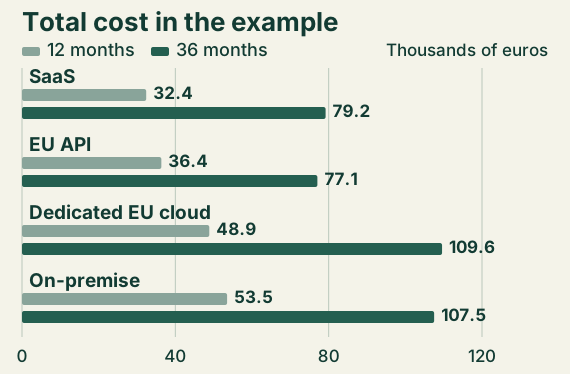 Fictional example for 25 active users, including an exit reserve. The table below shows unrounded euro amounts.
| Result | SaaS | EU API | Dedicated EU cloud | On-premise |
|---|---|---|---|---|
| Initial cost | 8,000 | 14,000 | 16,000 | 24,000 |
| Recurring monthly cost | 1,950 | 1,696 | 2,530 | 2,250.40 |
| Exit reserve | 1,000 | 2,000 | 2,500 | 2,500 |
| 12-month TCO | 32,400 | 36,352 | 48,860 | 53,504.80 |
| 36-month TCO | 79,200 | 77,056 | 109,580 | 107,514.40 |
Reproducible example: 36-month on-premise = 24,000 + 36 × 2,250.40 + 2,500 = EUR 107,514.40.
In this example, SaaS costs the least over 12 months. Over 36 months, the EU API costs EUR 2,144 less than SaaS. SaaS starts with less implementation work, while the EU API has lower recurring costs. Dedicated cloud and on-premise cost more at this usage profile. Additional control can justify that cost, but must meet a specific requirement.
Which assumption changes the decision?
| Change from the example | Calculated effect | What must be checked before deciding? |
|---|---|---|
| Ten times the API volume, everything else unchanged | Inference rises from EUR 216 to EUR 2,160/month; 36-month EU API TCO rises to EUR 147,040 | Can company-owned hardware actually handle this load with equivalent quality and latency? |
| Four extra operating hours per month | EUR 320/month; EUR 11,520 over 36 months | Which tasks are actually covered by the provider contract? |
| 100 extra rework hours per month | EUR 4,000/month; EUR 144,000 over 36 months | Which option passes business evaluation? |
| Redundancy or another GPU required | Initial and recurring costs increase by the specific quoted items | Measure capacity and outage requirements again; discard the old calculation |
Utilisation changes unit cost, not the amount already paid for hardware. Do not divide fixed monthly costs by a utilisation factor and treat the result as additional TCO spending. Idle capacity is already paid for. More load can, however, require another capacity tier.
Assuming unchanged on-premise capacity purely for arithmetic, the 36-month cost equals the EU API at approximately 4.92 times the original volume: API TCO excluding inference is EUR 69,280, so (107,514.40 − 69,280) / (36 × 216) ≈ 4.92. This is not a purchase recommendation: without load testing, it is unproven whether the hardware can handle roughly 49,200 tasks per month.
Scaleway explicitly notes that standard benchmarks do not replace the specific workload. vLLM documents input/output tokens, cache usage, time to first token and end-to-end latency, among other metrics. Measure business success as well.
Economics: cost per accepted task rather than per token
Cost per accepted task = TCO during the period
                       / business-accepted tasks during the period
In the hypothetical API example, a 90 percent acceptance rate would give 36,352 / (12 × 10,000 × 0.9) ≈ EUR 0.34 per accepted task. The 90 percent is an additional assumption, not a test result. A comparison requires each option's own measured success rate and rework.
TCO does not establish whether the workflow is worthwhile. That requires realised time gains, additional revenue or avoided cost relative to the existing process. Saved minutes do not automatically become cash flow. Plan an AI pilot explains a benefit hypothesis with a stopping criterion.
Compare quotes for Austria, Germany and Switzerland
Request quotes for the same scope. Specify data region, access, subprocessors, model licence, quotas, support hours, data export and termination terms. EU or Swiss hosting alone does not establish complete control or data-protection compliance.
For Austria and Germany, a euro budget can serve as a common unit. For Swiss quotes, convert CHF using a documented exchange-rate date or run the entire model in CHF. VAT, input-tax deduction and subsidies are checked separately; subsidies are not assumed as guaranteed savings here.
Safe Swiss Cloud's private AI price list illustrates separate items for chat, API and integration. It is a source for quote dimensions, not the basis of our example amounts. Check the specific licence terms for self-hosting; the Mistral Model Selection Guide includes licence information alongside features and prices.
Frequently asked questions
What does private AI cost for an SME?
A defensible total needs a specific workflow, quotes and operating assumptions. In this article's hypothetical example, dedicated EU cloud costs EUR 48,860 over 12 months and on-premise costs EUR 53,504.80. These are calculated values for a limited assistance workflow, not market prices or offers.
How many users make on-premise AI worthwhile?
There is no universal user threshold. Usage, quality requirements, concurrency, capacity and operational effort determine the outcome. A calculated break-even applies only within tested capacity and for a comparable scope of service.
Are SaaS licences and API costs the same?
No. A SaaS licence pays for a product with agreed features and limits. An API pays for model access; the application, integration and operations are additional. Add API costs to SaaS only when the workflow actually requires separate API calls.
Is EU cloud automatically private AI?
No. EU initially describes location. Dedicated capacity, network boundaries, access permissions, data paths and operating responsibility must be checked separately. An EU API can run on shared infrastructure.
Should TCO include hardware purchase plus depreciation?
Do not count the same asset twice. This model includes hardware purchase once. A separate profit-and-loss view can use depreciation instead; cash flow, cost accounting and residual value then need clear separation.
What belongs in exit costs?
Export, rebuilding indexes, adapting interfaces, re-evaluation, parallel operation and secure decommissioning. The example includes an assumed exit reserve at the end of each comparison horizon; it is not a cash payment already incurred.
Next step for a specific architecture decision
Do you have a workflow and need to decide its budget or operating model? Record task volume, quality target, allowed data paths, existing integrations and operational capacity. These inputs support a TCO calculation based on quotes and pilot measurements.
Request a specific architecture and cost comparison. The goal is a defensible decision with a clear scope, including the option to use an existing product or stop the build.